Dreams, theorized as the expression of repressed desires and fears that reside in the subconscious in psychoanalytic theory, have historically been inspiration to surrealist artists. Dilek Yaman’s exhibit In Dreams, We Unite takes dreams out of the subconscious and makes them the stuff of a different kind of longing, a longing for things realized yet not quite fulfilled. Her photographs do not simply convey a nostalgia for the past, but a yearning for a future made from that past. Yaman’s images capture a different kind of closeness and a different shape of the “domestic” that lie beyond a tired recycled “family” and family-home. They accomplish this by providing us with an alternate language to think about intimacy and world-making.
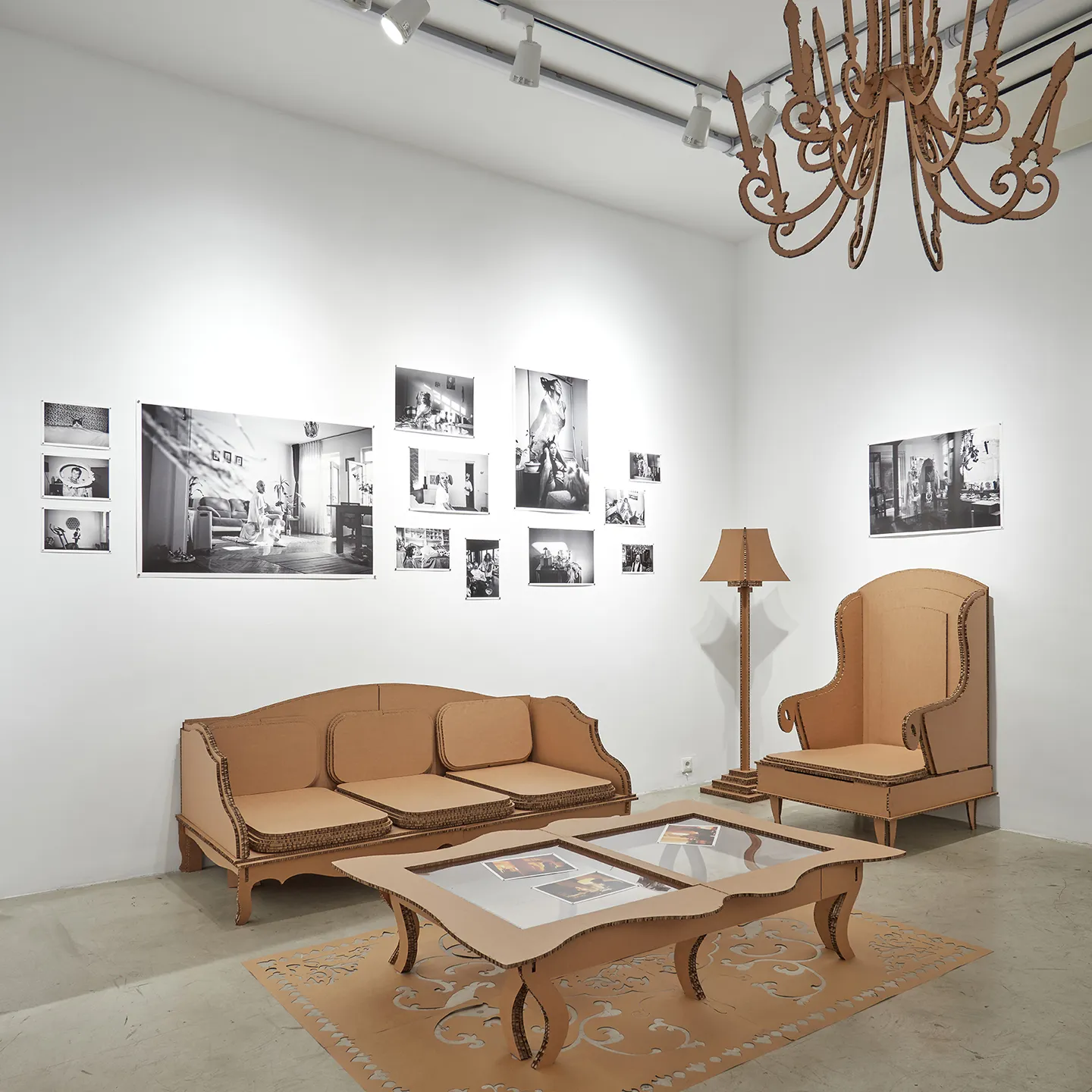
The photographs in the exhibit are displayed in a corrugated cardboard living room –the usual elements of a domestic space such as a dining table and chairs, a sofa and coffee table, a console all made of monochromatic cardboard are the backdrop against which Yaman’s images come to life: where her subjects and their “domestic” and undomesticateable locations bring color and vitality to the otherwise dull space. Dinner parties and dinner tables, dance floors and cabinets, bookshelves and thongs, family photos and platform boots, tattoos and toilets, crooked lamps and bent necks, wigs and cats and costumes and water jugs and blankets and plants and random decorative objects collectively tell us a story about the everyday as a party. In other words, they convey that there is a different way to do the everyday: the chores, the usual, and the ordinary can be rendered extraordinary. This extraordinariness, these dream-like spaces made out of the stuff of the ordinary invite the viewers to dream of a different world in order to meet in that dream. The vision of this world is not conveyed through images of streets, squares, and protests but through an everyday that is lived with a difference.
This suggestion that Yaman’s images invite us to think of an “otherwise” does not indicate that they are straightforwardly “hopeful.” In fact, one may say melancholy is to mourning what Yaman’s dreamy visual language is to simple hope. If melancholy, as theorized by Freud, refers to mourning without an object, mourning without knowing what exactly we have lost, Yaman’s visual language of dreams corresponds to hope without a particular object. By hope without a particular object I do not refer to a naïve and all-encompassing optimism, but rather to the belief in a possibility without overdetermining that possibility.
Hope is often associated with a “better” future, and what makes that future better is ultimately dependent on who is doing the envisioning. This “better future” has historically looked like population exchanges, wars, genocides, forced and/or nonconsensual sterilization of minorities, but also as the production of docile patriots, obedient workers, reproductive families through mass-education and otherwise. Hoping for a better future, with a clear idea of what shall be better for all is the stuff of fascism. A different kind of dreaming for a different kind of future cannot be attached to any particular idea of what shall come next. A hope without a fixed object, a dreamy language of something-else-to-be that we find in Yaman’s photographs is a remedy for the times when in Gramsci’s words “the old is dying, and the new cannot be born.” In Yaman’s photos we get a glimpse of the unborn that struggles to be born, to be seen, to be felt, to be imagined. She accomplishes this effect by simultaneously making familiar scenes unfamiliar, unfamiliar subjects familiar, and in the meantime by infusing the everyday with queer joy –like sitting on the toilet seat of a less-than-fabulous bathroom with a sequined dress down one’s knees, a toilet paper roll in hand.
Just as the future assumes complexity and openness in these images, so does the past. Photographs, differently from other visual mediums, are often perceived as more direct representations of life: of things, people, places and events. Indeed, some of the images in the exhibit may lead the viewers to such conclusions: This dinner party must have taken place at such-and-such person’s house, that party looks like so-and-so’s birthday. Whether these would be factually true or not, Yaman’s images are not simply about capturing moments as “history.” Here, it is also worth remembering that the past is not simply what is remembered or what is recorded. Critical historians and scholars of memory studies have for long shown that things are selectively remembered, that we at times even “remember” things that have not happened, and finally, that history reflects the “interests” of those who have recorded it, whether intentionally or not. A photographer always risks being mistaken for a documentarian –her challenge is to show us what forms of envisioning are made possible through the photographic vision.
Rollo May reminds us in The Courage to Create that it is the work of an artist (and any creative person, for that matter) to create new symbols, myths and metaphors with which to understand the world. Yaman’s visual language of intimacy and closeness without the family, of joy without conventions, of the everyday without mundaneness/boredom and of nonconformity without its traditional locations of the street and the square does exactly that: open the door to look at our worlds, our homes, our everyday, our intimacies, and reflect on what it may mean to remake them. The intimacies that are enabled by this domestic with a difference, and that in return re-make the spaces in which the moments of closeness are captured in Yaman’s images also blur the distinction between lovers and friends, inviting the viewers to reflect on what it means to share a life with others. After all, all intimacy is stranger intimacy until strangers become familiar through the labor of closeness, and of vulnerability.
If melancholy is a state of loss and despair without a lost object, therefore unable to be “cured” or impossible to overcome, the infectious dreamy world-making Yaman offers us is similarly “without a cure” –an orientation to an everyday that keeps on dreaming when it risks blame as being childish, naïve, politically misguided or altogether apolitical. It is a gesture to what cultural theorist Raymond Williams has termed “the emergent” –that part of culture that is coming into being up against the residual and the dominant. In a brilliant move that relocates dreams of a different time in the domestic everyday, in kitchens, bedrooms and living rooms but also parties that may or may not be “in the home,” In Dreams, We Unite offers us a visual language with which to dream of a different everyday, a different way to long and to belong, an alternative to conventional and dominant forms of closeness, and a vision of a world remade through these. May we all get to bask in the glow of the beautiful and magical world Dilek Yaman has created for us, and meet each other in dreams.